Equine welfare fundamentals
When we talk about horse 'welfare', it's their physical and mental health we take into account in ensuring they live healthy, safe and fulfilling species-appropriate lives, from birth until the end. Ultimately, all horses' experiences should be positive, their emotional wellbeing prioritised and their basic, biological needs are met while in our care.
In the UK, the Animal Welfare Act 2006 requires owners to ensure the welfare of any horse, pony, donkey or mule under their care. The Act 2006 (“the Act”) requires you to ensure that any horse, pony, donkey or mule for which you are responsible, whether on a permanent or a temporary basis:
- has a suitable environment to live in
- has a healthy diet
- is able to behave normally
- has appropriate company
- is protected from pain, suffering, injury and disease.
The Code of practice for the welfare of horses, ponies, donkeys and their hybrids provides detailed guidance on housing, feeding, training, restraint and health monitoring, including body condition scoring and horse passports. Compliance with the code is considered by courts when assessing welfare offences.
The 3Fs - friends, forage and freedom
As a basic provision, we must meet the three essential needs of the horses in our care: friends, forage and freedom. Developed by equine behaviourist Lauren Fraser, these are the fundamental pillars of equine welfare and they are reliant on each other - if not adequately covered the whole horse suffers.
Friends
Horses are very social species and, as prey animals, feel safe in a herd environment. They need social interaction for their wellbeing, to bond and play, mutual grooming and companionship. They have complex and subtle ways of communicating, so visual contact is required as a minimum, but physical touch wth other horses creates the best environment. Put simply, horses need other horses.
Forage
Horses in the wild spend typically 14 - 16 hours grazing and searching for food. Forage, including grass, hay, haylage, chaff and grass replacers, is vital for digestive health and we must ensure we provide as natural an environment as possible where they can trickle feed. Forage is important for gut fill and, as hind gut fermenters, horses need cellulose which is then broken down by bacteria for energy and the nutrients are absorbed.
The act of foraging also gives mental stimulation for horses - plus their lips, whiskers, tongue and nose, so try and provide forage in a fun and interactive way so it enriches their day. In the stable, feeding at ground level is best to mimic natural behaviour but ensure you're taking your horse's safety into account.
Freedom
This includes movement, choice and an absence of negative feelings like pain, hunger and thirst. A horse's natural instincts and need for freedom remain unchanged since before horses were domesticated and we need to ensure we don't compromise their mental and physical health with modern practice.
Wild horses were nomadic and could cover 10 - 20km per day in their search for food but in modern, domestic environments adaptations are often needed. Stabled horses move under one kilometer in a day so we need to ensure they have adequate time to move, forage and socialise. This could be time out in the field, loose schooling and of course riding and ground work, but the horse has little freedom to choose in the latter.
The Five Domains
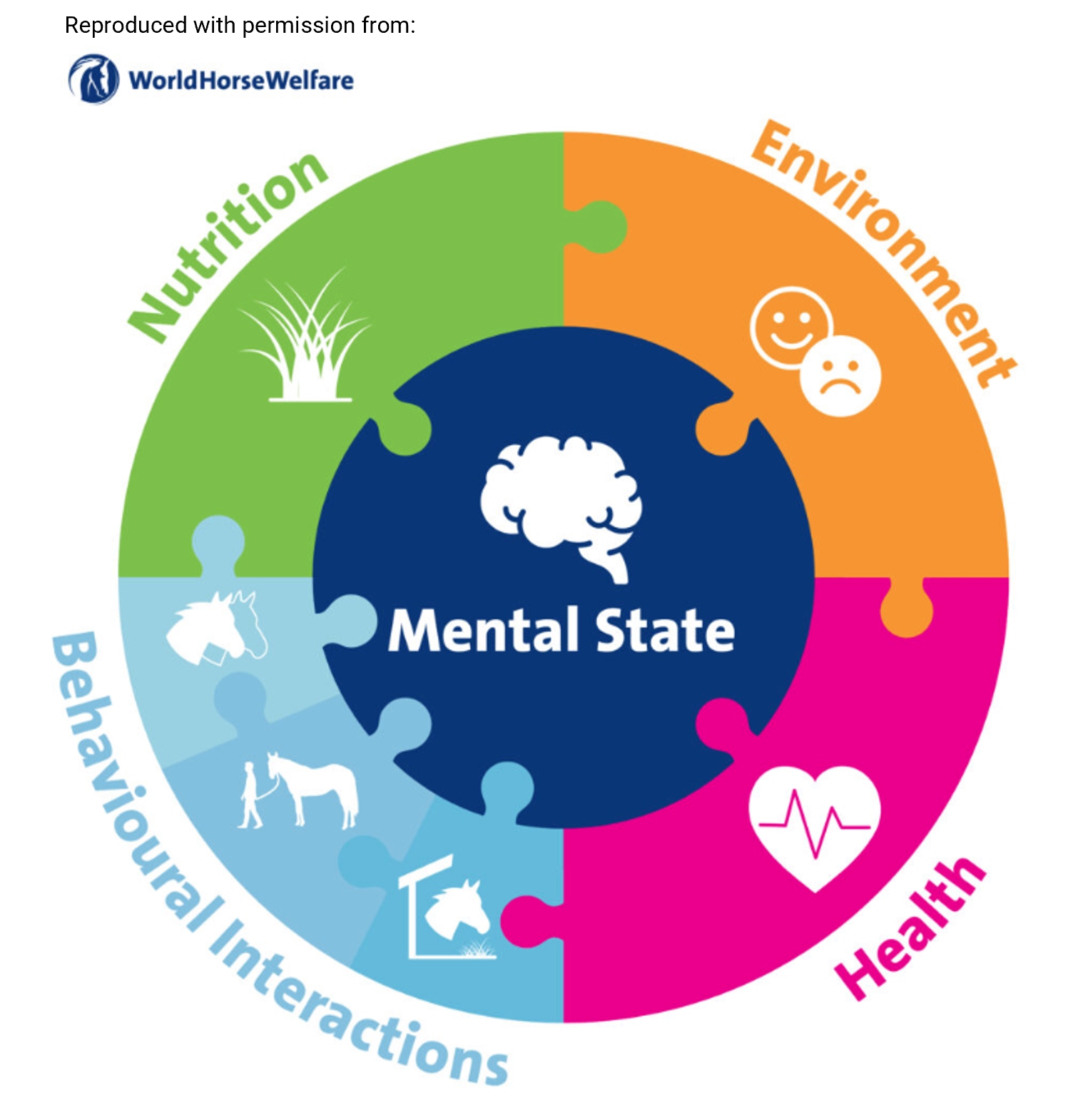
Established by Professor David J.Mellor, the Five Domains Model takes equine welfare to the next level and is a comprehensive assessment framework based on internal and external factors. We want horses to survive and thrive in their 'home' environment so it's important we measure that it's right for each horse.
At the centre of the model is the horse's mental state - how they feel and their response to thier situation. This is then linked to four physical or functional areas: nutrition, environment, health and behaviour. If an internal need like thirst can be met by having a drink, the horse is in a positive mental state. If they cannot find any hydration, they will fall into a negative mental state, which we want to avoid.
Our daily husbandry, training and care of horses should be centred around meeting the requirments and functional areas to ensure a positive mental state - never compromising their species-specific needs.
Leading equine welfare charity and advocates World Horse Welfare details the mininmum requirements in our guardianship as:
- Managing physical health is one aspect of horse care, but equally as important is managing their mental state through meeting their nutritional, environmental, health and behavioural needs
- Their diet should be forage-based, with their environment providing ample foraging opportunities; any additional concentrate feed should be provided based on their individual needs, with many horses requiring only a vitamin and mineral balancer in addition to forage
- Horses should have access to clean, fresh water
- Horses should have social contact with other horses
- Turnout increases movement which is essential for horses’ physical and mental wellbeing
- Horses’ environment should provide shelter from extremes of weather such as temperatures below freezing, heavy rain and temperatures exceeding 25°C
- You should be able to recognise the signs of good and ill health
- Implementing an annual routine health care plan can help prevent ill health
- Horses that are in pain or discomfort show signs through their behaviour; you should be able to recognise these signs and be proactive in identifying any underlying causes of pain.
For more detailed equine welfare and wellbeing essentials, vist the following topics on the World Horse Welfare website:
Our website has great resources to help on:
- Equine diseases to know about
- Biosecurity
- Weight taping and condition scoring
- Hot weather advice
- Worming
- Advice notes for equine gatherings
Plus, you'll find videos, resources and podcasts from previous editions of our Equine Health Week, in partnership with Agria, in the Health and Biosecurity section, under the main EQUINE heading above.