BEF guardianship and action plan
The horse is our guiding principle, and we must ensure the highest standards of welfare and mental/physical wellbeing for the equines and equids in our guardianship. Throughout their whole lifetime – at home, in training and at competitions, across all activities – they should have their basic needs met, be free from harm and treated with dignity and respect.
Our role in equine welfare
British Equestrian (BEF) and our 19 member bodies are committed to promoting the highest standards of integrity under an ethical framework in all equestrian activities and collectively we endeavor to help people learn and understand about horses and their needs – welfare should never be subordinated to commercial or competitive influences. Ensuring the wellbeing of horses is everyone's responsibilty.
As regulators, the BEF and our member bodies will collaborate to reduce the risk of equine suffering and harm through:
1. Applying a welfare-centric approach to regulation and activity planning
2. Providing information and education on best practice for those involved with horses
3. Adopting a robust response to any forms of mistreatment with effective sanctions for prohibited behaviour.
The BEF provides leadership on equine welfare policy and practice and expectations are laid out in the British Equestrian rule book.
All participants under the federation umbrella are required to comply with the British Equestrian Equine Ethics and Welfare Policy (see below).
British Equestrian Equine Ethics and Welfare Policy
Equally, all have an obligation to report concerns of abuse or mistreatment to their member body, the BEF or statutory authorities.
BEF welfare regulation strucutre
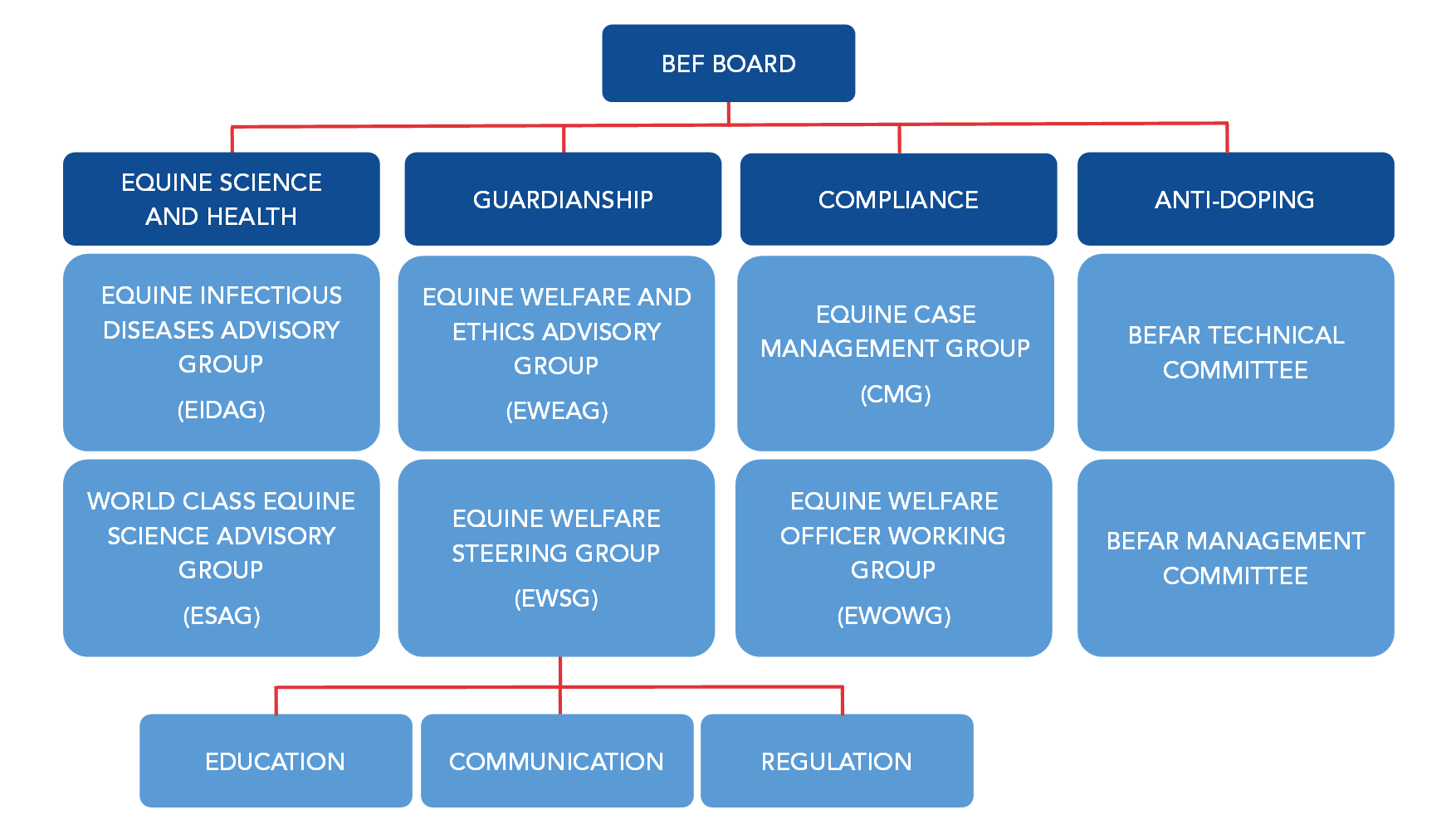
Under the leadership of the BEF Board of Directors, equine welfare is woven tightly throughout a number of groups and committees with a responsiblity for safeguarding our horses.
Equine Welfare and Ethics Advisory Group
The Equine Welfare and Ethics Advisory group is an independent body to provide guidance and recommendations in the key strategic area of equine wellbeing and standards. They work to provide evidence-based best practice, make recommendations on critical issues within equestrian sport and develop guidance to promote an ethical horse-human relationship.
Key areas of responsibility:
- Identifying key threats and challenges, both real and perceived
- Identify and collate current issues and consider scientific evidence to support best practice
- Provide a Federation-wide strategic overview of equine care, wellbeing and welfare in sport
- To identify areas in which further research is needed and identify research priorities
- Advise and make recommendations on areas where rule changes should be considered
- Advise British Equestrian on response to welfare issues
- Consider mechanisms for systems of equine safeguarding reporting
- Engage and collaborate with member bodies in the promotion of equine and wellbeing messaging, content and best practice, and strategic reputational work.
The Group’s composition is representative of expert roles in equestrian sport, equine veterinary science and governance to ensure there is a balance of viewpoints and any recommendations are appropriate and workable.
Appointed members of the group are:
- Independent Chair: Professor Madeleine Campbell BVetMed (Hons) MA (Oxon) MA (Keele) PhD DipECAR DipECAWBM (AWSEL) MRCVS
- Jim Eyre, British Equestrian Chief Executive
- Roly Owers MRCVS, British Equestrian Board Director and World Horse Welfare Chief Executive
- John McEwen MBE, BVMS MRCVS, BEF Director of Equine Sports Science and Medicine
- Richard Waygood MBE, British Equestrian Technical Director
- Iain Graham, British Showjumping Chief Executive
- Sarah Phillips, BHS Chief Operating Officer
- Lynne Bailey, British Equestrian Head of Integrity and HR
- Winnie Murphy, British Equestrian Head of Communications.
TErms of reference: Equine Welfare Ethics Advisory Group
Equine Welfare Steering Group
Tasked by the BEF Board, the Equine Welfare Steering Group provides oversight, guidance and direction on the implementation of new policy and regulation as well as an ongoing remit to review and improve the way in which the federation safeguards equines. The EWSG works to develop robust and effective oversight to ensure the primacy of equine welfare across the Federation that:
- Is founded on a robust regulatory framework
- Applies a welfare-centric approach to regulation and planning for events and activities
- Establishes awareness and education in relation to best practice for those involved with horses
- Adopts a robust response to any form of mistreatment with effective sanctions for prohibited behaviour
- Embeds a culture of using ethical, evidence-based practices in training, management, and performance.
The EWSG is broken down into three futher dedicated taskforces who cover education, regulation and communications.
BEF Chair Fields Wicker-Miurin chairs the committee, with CEO Jim Eyre providing oversight of the group comprising:
| Role | Education Taskforce | Regulation Taskforce | Communications Taskforce |
| Chair | Marcus Capel – TPC | Iain Graham – BS | Jason Brautigam – BD |
| Vice Chair | Sarah Phillips – BHS | Phil Nunnerley – BEF Council | Michael Bishop – RDA |
| BEF project lead | Adam Hughes – BEF | Lynne Bailey | Winnie Murphy – BEF |
| Welfare lead | Roly Owers – WHW | Mark Sinnott – FEI Vet | John McEwen – BEF/BD |
| Data/reseach lead | - | Lucy Goffe – BEF | - |
| Members | Charlotte Osborne – BD/CDAT Chair | Richard Davison | |
| George Baber – ABRS+ | George Wilson Fitzgerald | ||
| Claire Moir – BEF Board, BD rep | |||
| Rosie Williams – BE |
terms of reference: Equine Welfare Steering Group
The EWSG Action Plan 2026 - 2028
In July 2026, the EWSG released an action plan to detail the work of the three taskforces – a clear roadmap for continuous progress within the federation over the current four-year Olympic cycle and beyond. Since work started in 2025, progress has been made across priority areas such as:
- Enhanced welfare reporting
- Equine Welfare Officer Network
- Equine medication principles
- Stronger governance
- Coaching reform
- Disciplinary alignment
- Horse registration
- Communications
This action plan is being continuously reviewed, ensuring progress remains measurable and aligned with emerging challenges and opportunities. The work is underpinned by sport and activity-specific action plans developed by individual member bodies to ensure there is a concerted effort and coordinated approach across the federation.