Community Engagement Guide
A toolkit to foster inclusion
Our commitment
At British Equestrian and across the federation, it’s our mission to create a culture of everyday inclusion, at every level, in everything we do, and giving every individual the opportunity to thrive.
In November 2023, we proudly launched our Horses for All strategy, put together by a federation-wide working group, producing a strategy which we use to continue our work in making equestrian activities accessible for everyone.
Why is inclusion important for equestrianism?
Everyone deserves the opportunity to experience the incredible, wide-ranging mental, physical and social benefits the equestrian community has to offer – from building a bond with a special horse and connecting with others who share a passion, to being active in green spaces, developing new skills and growing in confidence.
See our social value research to discover the vast range of benefits of equestrian activity.
However, these benefits are only truly meaningful if they are accessible to all, regardless of background, identity or ability.
To be an inclusive centre means creating a welcoming environment, where everyone feels valued, supported to engage, and can experience the joy of being around horses. Our inclusive animations provide an overview of why inclusion matters and how we can embed it in practice.
What is the Community Engagement Guide?
.png)
British Equestrian, British Horse Society, RDA and member bodies part of the Equity, Diversity and Inclusion (EDI) Working Group have developed this guide to improve accessibility and inclusion in equestrian centres across the UK.
The guide includes a self-led toolkit and action plan to help embed EDI in your centre and effectively embed the Horses For All Strategy values.
Who is the guide for?
The guide has been created for use by all equestrian facilities, including centres, businesses and groups. These will all be referred to as ‘centre(s)’ in this guide.
The term ‘member(s)’ encompasses participants, employees, customers, freelancers, coaches, consultants, owners, officials, volunteers, spectators and anyone involved in the equestrian community.
How to use the guide
This guide provides advice for strategies and initiatives to create a welcoming and inclusive culture for all, covering different elements of day-to-day centre delivery. It is plit into five overall themes:
- Culture
- Data
- Delivery
- Communications
- Facilities
Each element includes a range of ideas or considerations your centre can work on, supported with top tips to help embed inclusion and accessibility in everything you do.
You can work through the guide at your own pace, evaluating what you already do under each theme and identifying areas for improvement. There are additional support, useful links and examples included throughout, so take your time and make use of the additional resources to expand your thinking in certain areas.
Download the full Equestrian Community Engagement Guide here:
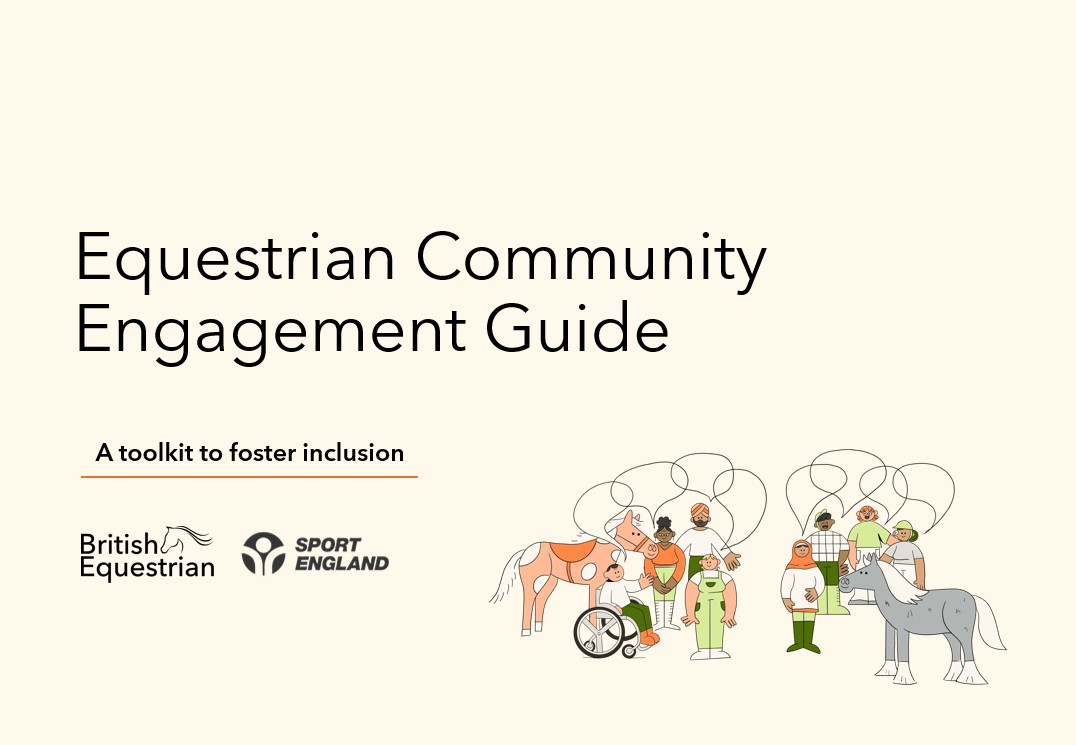
Equestrian Community Engagement Guide
The supporting action plan template is here to help you plan and record your progress, working throught the guide at your own pace:
Top tips
Culture
How does your centre bring inclusivity to everyday life?
- Make EDI visible through your values, policies and everyday actions.
- Create a welcoming environment where everyone feels respected and included.
- Engage staff and members in inclusive activities and learning.
- Continuously listen, learn and improve to meet the needs of your community.
EDI approach
- Make your commitment visible – a short EDI statement on your website is a great place to start.
- Share what inclusion means to your centre through your website, social media and newsletters.
- Create a policy to show your commitment and guide your team, see this policy template to help.
British Equestrian's Equity and Diversity Policy
EDI champions
- Nominate someone in your centre to act as EDI Champion – they can promote equity and inclusion initiatives.
- Create a small group of staff, members or local community representatives to support this work.
- Have champions for different areas, such as LGBTQ+ inclusion or cultural diversity.
Working with others
- Talk to your partners and sponsors about their approach to EDI.
- Share ideas and learn from each other.
- Work with organisations which align with your values.
Celebrating diversity
- Create opportunities for members to share their experiences.
- Mark key awareness campaigns throughout the year with small events or activities, use a diversity calendar for ideas.
- Consider joining recognised programmes that reflect your commitments, such as Disability Confident, the Sunflower Scheme or White Ribbon.
Learning and development
- Help members understand your centre’s values, policies and expectations.
- Support staff with EDI learning – this could be informal or through structured training, RDA Learning offers online courses and resources.
- Focus on areas where you’d like to grow, such as disability inclusion or cultural awareness.
Reporting concerns
- Make sure everyone knows how to report bullying discrimination or inappropriate behaviour.
- Have clear, accessible policies such as, code of conduct, safeguarding, complaints.
- Keep records of concerns for learning and spotting patterns.
Our Safe To Play website offers plenty of safeguaurding advice and an easy way to report concerns.
Member engagement
- Get members involved through events, social media or themed activities.
- Offer a variety of inclusive, accessible opportunities and ask your members what they’d like to see.
- Recognise and thank those who support inclusion at your centre.
Data
What EDI data does your centre collect, and how do you use it to shape decisions?
- Keep it simple – you don’t need lots of data to get started.
- Be clear about why you’re collecting data and how it will be used.
- Always make data collection optional and explain how you’ll protect people’s information.
- Most importantly, act on what you learn – even small changes can make a big difference.
Understanding your workforce
- Collect basic demographic information about your staff to understand how diverse your team is.
- Use this information to spot gaps in representation and think about how you might address them.
- Look across different roles, for example, does diversity change at more senior levels?
See Sport Structures: Power of workforce diversity.
Use our standardised questions to understand what questions to ask:
Getting to know your members
- Collect demographic information from members to understand who currently engages with your centre.
- Identify any underrepresented groups and consider how you might make your offer more accessible.
- Use simple templates and make sure you follow GDPR and privacy guidance when collecting and storing data, see GOV.UK Data protection.
Listening to member experiences
- Regularly ask members for feedback through surveys, conversations or suggestion boxes.
- Look at feedback alongside diversity data to understand difference experiences.
- Use what you learn to make improvements and how members their voices are being heard.
Reaching new audiences
- Use local data (such as Office for National Statistics or council data) to understand the community around your centre.
- Compare this with your current membership to spot who might be missing.
- Create simple outreach ideas to engage those groups, perhaps link with your local Active Partnership for support.
Delivery
How inclusive is your centre’s delivery, and how do you support your members?
- Inclusive delivery ensures activities are accessible, welcoming, and adaptable to different needs and abilities.
- A varied programme, responsive coaching, and member feedback help remove barriers to participation.
- Flexible pricing, financial support, and accessible equipment can make a real difference to engagement.
- Staff training and strong partnerships support continuous improvement in inclusive practice.
Making your sessions inclusive
- Offer a range of activities that are accessible to as many people as possible, Activity Alliance offer plenty of resources and ideas.
- Think about different needs such as confidence levels, physical ability, cost or experience.
- Be flexible in session delivery so more people can take part and feel comfortable.
Supporting different needs
- Create tailored opportunities for different groups, such as older adults, disabled people or LGBTQ+ members.
- Work in partnership with community organisations to better understand and support local needs.
- Be a visible champion for inclusion by actively welcoming and supporting underrepresented groups.
Inclusive coaching and staff development
- Provide training so staff feel confident delivering inclusive sessions.
- Encourage ongoing learning around accessibility, inclusion and adapting activities, Activity Alliance's Get Out Get Active learning is a great place to start.
- Appoint an inclusion lead or champion to support and review practice across the centre.
Flexible access and pricing
- Offer flexible payment options where possible to reduce barriers to participation.
- Consider discounts or concessions for groups such as students, retirees, disabled people or those on low incomes.
- Provide different ways to pay (not just card or cash) to make access easier.
Financial support
- Explore small grants or bursaries to support members who need extra help.
- Look at external funding sources, donations or community grants, check out our funding support page.
- Make sure information about financial support is clearly promoted to both current and potential members.
Inclusive equipment and resources
- Provide equipment which supports a range of needs, use Activity Alliance's guide.
- Share or recycle equipment where possible to reduce costs.
- Encourage donations of unused equipment and make sure people know these options exist.
Communications
Are your centre’s communications accessible, welcoming and representative of everyone?
- Use a variety of accessible channels so everyone can stay informed and engaged.
- Ensure imagery and content reflect the diversity of your community.
- Communicate clearly and respectfully using inclusive language.
- Regularly review and improve based on member feedback.
Reaching everyone
- Use a mix of communication channels – website, social media, email, newsletters and printed material and check out Activity Alliance's inclusive communications guide.
- Ask member how they prefer to receive information.
- Work towards making all communications accessible, including your website, find out how to build an inclusive website.
Inclusive imagery
- Use images which reflect a wide range of people and experiences.
- Ensure different groups can see themselves represented in your content.
- Feature your own members to reflect your real community.
Social media
- Share content in an accessible way such as adding captions to audio, clear visuals and simple language, check out our social media checklist.
- Promote inclusion throughout the year with awareness campaigns and celebrations.
- Actively monitor platforms and address any negative or inappropriate behaviour.
Inclusive language
- Use clear, respectful language across all communications, British Horse Society have produced a helpful inclusive language guide.
- Stay up to date with appropriate terminology and be open to learning terms.
- Encourage open conversations with members about language and lived experience.
Facilities
Are your centre’s facilities inclusive and accessible to everyone?
- Think about the whole journey, from arrival to departure.
- Regularly review buildings and spaces to identify and remove physical barriers.
- Provide inclusive toilet, changing and catering facilities to meet diverse needs.
- Use feedback and ongoing improvements to create a welcoming, accessible environment.
Centre location
- Check how easy it is for people to reach your centre. Consider factors such as vehicle access, wheelchair and pushchair access, and public transport.
- Work with your Local Authority and use Activity Alliance's accessible spaces guide to make improvements where possible.
Venue accessibility
- Review accessibility of your centre, including parking, entrances, lifts, doorways, lighting, signage and sound.
- Ask member for feedback and make changes.
- Use Sport England's accessible venues guide to help make improvements.
Toilets and changing facilities
- Ensure toilet and changing areas are accessible and meet a range of needs, Sport England provide useful information on this.
- Provide a mix of facilities where possible, including gendered, gender-neutral and fully accessible options.
- Small changes such as improved signage or privacy dividers make a big difference.
Catering and refreshments
- Offer food and drink options that meet different needs, such as vegetarian, vegan, gluten-free and Halal, check out Public Health's guide on food for religious faiths.
- If you can’t provide these, look at sourcing them externally.
- Clearly display allergen information and keep it up to date in line with GOV.UK's allergen guidance.
Useful links
Many websites offer useful advice, from equity and diversity within equestrian organisations, to disability and inclusion in sport and online.
See our useful links to gather more information and ways to make your centre more open to the community.
Member bodies
British Equestrian is made up of 20 member bodies, each of which is an equestrian organisation in its own right.
Between them, they represent over 280,000 people with a wide range of equestrian interests, from elite competitive sports to trade and leisure activities.
Our member bodies can provide access to information, guidance and resources around areas such as inclusion, safeguarding, welfare, participation and good governance.
They host workshops, webinars, CPD, connection opportunities and resources to help organisations develop their volunteers, coaches and workforce.
Learn more about our member bodies.
The guide
Download the full Equestrian Community Engagement Guide:
Equestrian Community Engagement Guide
The supporting action plan template is here to help you plan and record your progress, working throught the guide at your own pace: